Monday, April 26, 2010

Basket Weaving 101

The Azu-nah left me to myself for most of the afternoon. I rested for a while in my tree tent and unpacked a bit. Much of my pack, as I’ve said, is composed of life support materials. But I feel very uncomfortable keeping my entire supply on me all at once. One really bad fall and the entire thing can be destroyed. And while I’d be physically safe waiting for a supply drop from Ground Zero, they wouldn’t appreciate it, and it would quite literally shorten my time on the planet. We only have so many supplies stored. Ships regularly go back and forth between Epsilon Eridani and Sol, but, you know, it’s like the interstellar Pony Express.

So I carefully unpacked my kit and hung the stuff not immediately needed on the odd shelf-pocket that made up the top corner of the tree tent. My pack actually comes apart a bit, so I was able to disassemble it into something that would be better for carrying my day-to-day tools: computer pad, life support/first aid supplies, ration bars, comlink, binoculars, multi-tool, and my survival knife.

The tree tent itself was quite fun. I’ve always liked tents. I turn into a little kid for a few seconds no matter how many times I climb into one. It reminds me of camping as a kid, breathing fresh, wild air in the morning and listening to owls and insects and bats. The tree tent is made of a really odd fiber. It isn’t woven, like cloth, but it doesn’t seem to be leather either. It has tiny holes in it here and there, and the texture is oddly stiff. Outside, the bottom is braced by a woven pallet of slim branches, which provides a basket-like floor to sleep on. Inside, it feels less like a tent, and more like being wrapped in an enormous leaf. I liked it immediately.

It didn’t take me long to unpack, repack, and enjoy a twenty minute catnap. Beyond that I didn’t know what to do. So I ended up climbing down from my tent and wandering around. Kohric was nowhere to be seen. I assume he was off chatting with his friends, recovering from spending two and a half days with the wheezy, grunting, troglodyte woman. The other Azu-nah I encountered seemed to have been warned that I didn’t speak much of their language. They bobbed their heads in greeting or said a simple “kaganu.” I attempted to mimic their head bobbing, feeling like I probably looked more like a really bad rock music fan, and returned their greetings.

The Azu-nah camp is difficult to define, visually. There is no visible boundary where wild land ends and D’Keda begins There isn’t a lot on the ground that’s obviously camp-like. The trees are filled with the odd tree tents, but since they’re mostly much higher off the ground than mine, you don’t really notice them right away. They’re hidden in all the foliage. There are a few tents on the ground, but even they’re hard to see initially. They’re perched right up against the trees, like a big root extension, and they’re colored exactly like the trunks. I get the feeling the Azu-nah don’t like to make things that stand out against the natural background.

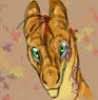
As I was wondering, a small, grey-brown Azu-nah female with black stripes on her back trotted up to me and gestured. She moved her hand and tail in a scooping, “come” gesture. Even with my utter inability to read Azu-nah body language, she seemed to exude a sense of authority. That, combined with the creases around her eyes and mouth, and my brain immediately labeled her as “Grandma.” I followed her to a circle of other Azus surrounding an enormous pile of flat, dry grass. Several of those in the circle had half-finished baskets in their hands, and were skillfully weaving pieces of grass between reed supports. Apparently Grandma figured I better make myself useful. A tawny yellow female came to sit next to me, introduced herself as Oreeaht, and set a freshly made reed base in my hands. She began carefully showing me how to weave the grass onto it.

I slowly got the hang of it. My basket was small, and I was incredibly slow. The others were working on much larger ones, and their fingers seemed to move without them even paying attention. They sang as they worked; a rhythmic, repetitive series of chanted words and whistles, with their tails gently thumping the ground behind them to add a drum-like base. I found myself humming the tune after the first few repetitions, much to the delight of Oreeaht and Grandma (later introduced as Nanahan).

Several hours, three paper—er, grass cuts, and a lot of good natured teasing later, and I had completed the Ugliest Basket Ever. The weave is lumpy and uneven, but dammit, it can hold things! Oreeaht, grinning just as Kohric had, kept pressing it into my hands when I’d try to put it in the pile with the others. Apparently I’m to keep my hideous basket to myself, thank you very much. I grinned and thanked her (“hetche”) and headed back to my tent. It was growing dark, and most everyone was making for their own tents.

I set my basket down in the corner of my tree tent and decided it’d be a good place to store my rations. I’d been avoiding eating Azu-nah food, and as of yet I hadn’t been directly offered any. I’m afraid of offending someone by putting some of it in my test kit. I don’t know how to articulate that I really appreciate their food, but I don’t know if it’s any good for troglodyte grunting alien women. I’ll have to do something soon, though. I can’t just blow through my rations in a week and a half.

Tomorrow, I’ll have to sample Azu-nah cuisine.

Monday, April 19, 2010

D'Keda

This morning dawned bright and clear. There’s barely been a cloud in the sky since I’ve landed on the planet. Weather data we collected on the Marco Polo before heading down said my part of the planet is in the middle of their warm season, which is also a major dry spell. I’m grateful for the timing. I can’t imagine making this trek hock deep in snow or sopping wet with rain.

Kohric and I have been slowly trying to exchange vocabulary as we’ve gone on. And today we made a bit more progress. It’s been incredibly difficult. When you think about learning a language on Earth, you generally worry about becoming fluent. You pick up the basics and then work on your vocabulary and grammar until you get really good. Usually you have some sort of teacher or program to guide you.

It’s very, very different when you just don’t have that last bit. There isn’t anyone to ask for help. Even the simplest things are more difficult when you have no common language. This morning, Kohric pointed at a flying creature and said a word. Well, of course he must be saying the Azu-nah word for that animal, right? Well, maybe. Or it may be a word for “flying,” or the word for that class of animal (like “bird” versus “robin”) or he may have been describing its color.

You see where this gets tricky?

So, as you can imagine, it’s taking us a long time to get anything down. At this point, Kohric is actually trying to teach me a set of gestures that will help us teach each other actual vocabulary. For example, when Kohric points at something with his hand open, and all the fingers pointing at the object, I know he’s giving me a general name for a type of thing. “Animal”, for example, would be an open-hand word. A single finger pointed at a thing is its specific name, like “chestha.” This is working well so far. It’s going to get tougher when we get into verbs and other abstract concepts.

Kohric’s an incredibly patient teacher. I wish I could ask him if that’s why he came to meet me.

On our one and only rest break before encountering D’Keda, Kohric switched gears and tried to give me a crash course in Azu-nah manners. That was tough, and our break was a lot longer than the others had been. I got some very basic concepts down at least. A polite greeting involves bobbing your head once, and pressing both your palms to those of the other person. It is not good to touch another person’s things or go into their home/space without permission. Permission is given by word, or another gesture that’s a head bob that ends in a little bow.

I was a nervous wreck as we made our way into D’Keda territory.

As we drew close, I began to see a few signs of habitation. Carvings on the occasional rock, a basket hung on a tree branch, and painted symbols on many of the trees. I kept straining my eyes looking for the main camp. I think I was subconsciously expecting to see something out of a History of Man movie, with a big fire pit surrounded by leather tents, with spears and knives lined up for the next hunting party.

Azu-nah camps are much different.

We approached a spot where there were few trees, a kind of mini-plain. A handful of Azu-nah were crouched there, each worrying at an object in their hands. Kohric whooped and said something to them. After his slow, careful speech with me, he sounded like a Spanish football announcer. The other Azu-nah all jumped up and clustered near me. Their eyes seemed huge with them up close, and they were all speaking to me, but I couldn’t understand more than a handful of words. They were all different colors, and some had some fantastically detailed designs on their bodies.

“Hello,” I squeaked.

Suddenly there were more of them. They came down from the trees. I gaped up at them stupidly, watching as they slithered and slinked down the trunks and branches like an entire tribe of big cats. Amidst the rainbow of Azu-nah, I caught a glimpse of draping hammock-shapes in the trees. I barely had time to register that before the entire tribe crowded near me, chattering excitedly. I felt like the last donut at a corporate morning meeting. The only word I could really pick out was “welcome,” yalalea, which made me feel a bit better. But I still couldn’t help feeling like a piece of meat tossed into a piranha tank.

It took nearly an hour before things quieted down. Each and every one of them insisted on pressing their palms to mine and bobbing an excited greeting. By the end my neck was aching, but I was thrilled. I never expected such an excited, enthusiastic greeting. I figured I’d be the equivalent of the Thing that Ate Schenectady, and there’d be a wary few who’d come near me, while the rest would treat me like a leper.

Kohric seemed to think I’d had enough and brought me to a huge tree with thick, low branches. On one of the lowest was one of those odd, draped hammock things I’d seen before. It was actually more like a tent held suspended in the tree. It wasn’t much bigger than me, really. There’d be enough room for me, my pack, and maybe one other person if they didn’t mind being practically in my lap.

“Home,” Kohric said, pointing at the little hut. He leapt easily up the tree and pulled a flap open for me to see inside. “Yalalea!”

I grinned and followed him up into my new home.

Wednesday, April 14, 2010

Chestha

Kohric tied a thong made of braided grass around the base of the redeka tooth. He insisted I keep it with me, but he couldn’t articulate why. He just didn’t have the vocabulary. He did clutch it to his throat, perk his ears, and threw his head up and back and forth.

I figured he wasn’t trying to say the tooth would improve my dancing. I think he was trying to tell me that it will give me energy, or perhaps vitality.

Or extreme raver powers.

Regardless of the reason, I was grateful for the gesture. I was so shaken from the attack that I spent the rest of the afternoon jumping at every sound around us. Kohric didn’t seem as concerned, but I did notice he would rock back on his haunches and scan the horizon with an intensity he hadn’t shown since I’d met him. Maybe he was a little rattled too.

My canteen’s top had broken from my lucky redeka sucker punch. I lost about half its contents to spilling, but I didn’t want to go near any more water sources to fill it. By late afternoon my head was starting to ache from mild dehydration. I was also starting to cough a lot.

Minervan air and water is rich with chemicals that are very rare compared to Earth, and they aren’t that good for human health. Chlorine is one of them. There isn’t more than a trace of it in the air, and it isn’t enough to cause you problems from immediate exposure. But human physiology doesn’t really like chlorine, and long term exposure messes with your respiratory system. And it makes your eyes itch like hell. Fortunately my life support kit includes medications and reagents that protect me from long term exposure to chlorine, and the other nasties in the water and air. About two thirds of my entire pack’s contents are taken up with my life support kit: anti-toxins, vaccines, antibiotics, and testing equipment. Minerva was never meant to host human life. We need all the help we can get.

During our next rest stop, I took the opportunity to do a quick diagnostic on my vitals, dosed myself with my tri-daily hit of anti-chemical-death-juice, and waited for my lungs to stop itching. I’d been an idiot and not dosed myself this morning like I was supposed to. Laziness punished. I wonder what the Azu-nah have that protects them from chlorine.

We had chosen a high hill to take our rest. I only needed two pit stops today, instead of my four yesterday. Hah! Improvement! Anyway, the hill gave us a really nice view of some of the surrounding territory. Kohric pointed to an area near the horizon where the trees became a little denser. Nothing you would call a forest, but enough that it really wasn’t what you’d call open.

“D’Keda is there,” he said, his ears were high and his lips curved up a just a bit at the corners, with his mouth open just a little. (This was an Azu-nah grin, I discovered. We’d had a grunting, gesturing exchange on our walk, and he’d managed to explain it to me a bit that ears play a bigger part in Azu expressions than the mouth in most cases.) Tomorrow mid-morning we’ll reach D’Keda’s current encampment.

Between our hill and the distant camp was a herd of creatures I hadn’t seen yet. I sketched one after a good long look through my binoculars. Kohric calls them “chestha.” Apparently they are “good food” and “very fast-turning”. I think that probably means “agile.”


These things have three sets of legs. They move like nothing on Earth. The only hexapods we have are insects, and their leg structure is sprawling; totally different from the chestha. These guys have a long, rolling gate. They have at least one foot on the ground at all times, and the legs on one side move one after the other, in a row. Front-middle-back on one side, then front-middle-back on the other. I only saw one of them run, and only for a second, but it was incredibly fast. I’ll bet they’re hard as hell to catch.

We watched them for several minutes and then continued on. We made another couple kilometers before it started to get dark. Now I’m sitting awake, bundled in my sleeping bag, and staring out across the hills into the night. Minervan creatures are making their alien sounds again, and every once in a while there will be a flash of blue-green light somewhere out in the darkness. Kohric is sleeping next to me. I've got the redeka tooth in my hand. It's soothing to run my thumb across while I'm thinking.

I wonder if I’ll be welcome in D’Keda. Will I ever get enough vocabulary under my belt to communicate better than a two-year-old? I’m going to be depending on them for so much. I’m literally the only one of my kind within a thousand kilometer radius. It’s exciting, usually. But tonight, I feel naked and alone.

Monday, April 5, 2010

Making Water

Today began the second day of our journey. Kohric said we should be at D’Keda tomorrow morning. I was told only two days, but I guess I can’t ask for a refund.

I freaked Kohric out this morning though. Would you believe Azu-nah don’t pee? I didn’t intend to have him be partial to that particular part of my morning ritual. I sneaked behind a thing that looked rather like a bush, and was mid-stream when I heard a sharp…er.. I guess you could call it a squawk. It transcended species. I knew it was a sound of dismay.

Kohric came charging up to me. I, still with my pants around my ankles and desperately trying to finish up, tried to look as calm as on could in such a situation.

“You make water! Tee needs … needs doc-tor!”

Oh for the love of… How exactly does one explain taking a piss to an alien?

“No, no!” I waved my free hand in a negative. “This is normal for humans. This is… er.. how I … er. Removing waste…. It’s peeing! I’m fine!” I hurredly hauled my pants back on. “It’s okay, really.”

He seemed a little mollified, but still eyed me like I was going to grow a second head from my ass. “Not sickness? Tee safe?”

“Safe. Healthy. It’s okay.”

All at once he seemed to make up his mind. He shook his head vigorously and bobbed it up and down several times. “With Azu-nah, making water is sickness.”

Note to self—See any Azu-nah having a morning pee, immediately call for help.

~~~~~~~~~~
Several hours into our hike, we came across a thin stream with a great deal of trees and scrub surrounding it. Kohric lead us to it for a drink. I sat down and slowly filled my canteen, grateful for the rest. Kohric took quick, nervous gulps, looking up and around after each sip. His ears never stopped moving.

“What’s wrong?” I asked.

Something suddenly exploded on the opposite side of the creek. A huge dark shape splashed across toward us. Kohric leapt straight up, did a half turn in mid air, and landed running. I shrieked in terror and scrambled to my feet, my heavy pack making me much slower than Kohric. I had a half second to register something the size of a horse careening toward me, when my logical mind shut down and whatever bit of my synapses dedicated to survival kicked on.

I swung my arm hard toward the thing’s face, whipping my canteen at it by the strap. My canteen was full, and I heard it crack across the thing’s muzzle. The creature made a sound that was half hiss, half yelp, and backed away. Something wet and hard hit my cheek and bounced against my collarbone.

I didn’t waste any time. I didn’t look back. I bolted after Kohric at a dead sprint. We slowed after a time, but kept walk-trotting for another several kilometers.

Finally, I couldn’t go on anymore. I flopped into the grass. I could barely see straight, and my breath was ragged. “What was that?” I wheezed when I’d finally gotten a little breath back.

Kohric looked solomn and reached toward the front of my shirt. He plucked something white and oblong from where it had wedged between my pack strap and its padding. It was smooth and pointed at one end, ragged and coarse on the other. A broken tooth.

Redeka,” Kohric said, staring at the tooth. “Was redeka.”

Monday, March 29, 2010

Tachivenator astrocirros

To my credit, I did not scream like a little girl when it happened. I did jump, I hit my head on the top-most tent pole, kicked over my pack, and definitely said a few words that are less than appropriate for polite company. My adrenal system is probably fried for a good two months.

I’m getting ahead of myself.

So, this morning, I encountered the locals. Or, perhaps it should be said they encountered me. I’d been sleeping lightly all night. The night sounds on Minerva are creepy as hell. Things kept whooping and booming and shrieking in the dark. I didn’t know whether they were Minervan equivalents of owls, or whether it was some flesh-eating terror that would descend on me and eat my entire camp, tent and all, in one go. So I slept with one hand on my survival knife and my emergency comlink under my pillow.

It was just barely getting light when I heard rustling in the grass. It didn’t sound all that close, but it made me jumpy just the same. So I crept to the door of my tent, flipped the silencer on the zipper (gods, am I grateful for that innovation), and opened the flap.


So, yeah, totally didn’t scream like a girl. Just swore enough to curl paint and shrivel plant life.

“Good morn-ning!” it said, and showed its teeth in a horrific grimace.

I don’t remember exactly what I said in response. It was something intelligent. “Urrhh.. “ I wiggled my fingers in a pathetic wave.

“A D’Keda yalalea,” it continued, slowly mimicking me by wiggling claw-tipped fingers. I finally managed to coax my heart back down into my chest, and my brain slowly registered that it was saying “welcome.” Things that plan to eat you don’t welcome you first, in my experience.

My voice didn’t even shake that much. “Kaganu,” hello, I said. “Doku oki Tee.” I’m Tee.

Its grimace widened, and I finally realized it was trying to give its best human smile. I found myself grinning. E for effort, dude. “Doku oki Kohric,” it continued, and turned enough for me to see that its mane ended in a tuft between the shoulders. Really was a dude, then. He was gesturing, pointing to me and the tent, and then out over the hills ahead. “Come. Tee to be with D’Keda, yes?” He had a very odd accent, and spoke English very slowly. “Tee and Kohric go. Come!”

For all that he seemed to be in a hurry, he was very patient while I broke camp. He watched everything I did, sticking his long snout into every pocket of my pack, grappling at every piece of equipment, and even went so far as to lick my computer pad. Gross! And how do you deal with that? He was as tall as a Saint Bernard, but you generally don’t make good diplomatic relations with someone when you treat them like a dog. Down! Down! Bad sentient alien! No treat for you. Yeah, great. I plucked the computer from his paws with a smile fixed on my lips and tried to distract him.

“Is D’Keda far away?” I asked.

He flicked his enormous ears and looked blank. I pulled up my woefully insufficient dictionary and tried again. “Is D’Keda tay?”

This time I knew he got it. “Tay. Far. Tay. Hai! Yes! Hai. Two days. Come! Tee and Kohric go!”

Oh great.

I finished breaking camp and we headed out. After about two hours I was huffing like I’d run a 40K marathon. Kohric stopped and stared at me intently. He reached out one hand, pointed to my chest, then swung his finger up to point at my mouth. “Tee has weak breath?” he asked. He said it like you would say “Tee has botchulism?”

Awesome. Less than a day in and my guide already thinks I’m a first class weenie. “Breath strong in a few days,” I said, hoping he wouldn’t think I was a total charity case. I tried to slow my breathing and fixed my posture. “I’m fine. It’s okay.”

“We rest much until breath strong,” he said, and flopped down into the grass.

Damn.

Three rests and some unholy number of kilometers later and we stopped for the night. Kohric seemed disturbed when I went to set up my tent again, so instead I unrolled my sleeping bag and set it down right in the grass. I hoped there were no Minervan equivalents to scorpions running around.

Kohric seemed to be pleased that I was sleeping out. He pointed to the sky. It was a beautifully clear night. "Azu," he said, gesturing to the sky.

"Sky?"

"No," he said, and pointed again. "Azu." He shifted his hand and pointed again. "Azu." Then again. "Azu." I realized he was pointing at the stars.

"Stars," I said, feeling triumphant.

He did his horrible human smile imitation again. "Yes." I seemed to have made him happy.

The scientific name for the Azu-nah is Tachivenator astrocirros. It means "swift hunter from the orange star." The word star seemed to be in their name for themselves too. Sometimes I think life has more of a sense of humor than we realize.

Tuesday, March 23, 2010

First Encounter?

This morning the short-range shuttle from Ground Zero station dropped off first Ed, then Dr. Sutherland, then me on Minervan soil. We couldn’t take the Marco Polo into the planet’s atmosphere. Sub-light ships are specially designed for their purpose. They’re built to go fast, and if you ask for anything more complex, like, say, being able to land, or even just functioning in an atmosphere with significant drag, the ship doesn’t do so hot. Well, it blows up, actually. Hence the shuttle.

(Damn, are those things cramped. I mean, I’m not a big person. I’m only about 1.6 meters tall, and I was having a hard time standing upright. Poor Ed’s over two meters. He looked like a toy someone had smooshed into a box after playtime was over.)

The shuttle took a round-about course across the planet. We’ve each been directed to interact and learn from a specific Azu-nah tribe, each in a different environment. Ed was dropped off in an area that seemed to vaguely resemble a rain forest, except it wasn’t really hot at all. Dr. Sutherland is going to be plunked down in a desert. Don’t ask me why the planet scientist guy chose the place with the least plants. Guess desert slim molds are hot stuff.

I’m going to be in an environment that we don’t really have an Earth analogue for. It’s a bit like a prairie or pampas, a bit like a temperate forest, with a little chaparral thrown in the mix. It’s a hilly, sweeping environment with long swatches of grass and short, shrubby plants. There are individual trees that dot the grassy areas every handful of meters, and then there are larger more forest-like patches of large vegetation and trees near rivers and streams. It has distinct wet, dry, and snow seasons. Wacky biome if you ask me.

I’m to meet with the resident clan from this environment. My reference material says they’re called the “D’Keda” clan. I don’t have a clue what that means. Actually, I have so little info on the Azu-nah that it’s almost laughable. Here, this is the detailed species synopses they gave us.


Isn’t that sad? There’s no information! Who cares how tall they are! I want to know what not to say so they won't feed me to the closest carnivorous plant! The species info came with a very little, very basic Azu-nah vocabulary (like, I can say hello, goodbye, yes, no, and “where is the bathroom” and that’s about all). I’ll be lucky if I move past pointing and grunting in the next month. Fortunately the first contact team spent a little time with D’Keda, and left them with .. well.. basically kids learning toys to help them pick up English for the last couple years. Hopefully that’ll help. But those things are basically glorified Speak-and-Spells. I have a feeling there will still be a lot of Me Tarzan, You Jane talk for a while at first.

I spent the afternoon hiking across a high, hilly ridge, looking for them. The clans tend to be semi-nomadic, and range across a home territory. So while I know they’re somewhere in this area, I have no idea exactly where. So I’ve been just kinda wondering and looking for signs, while trying not to step on something that’ll bite me.

Being on an alien world is disconcerting like you would not believe. Have you ever been to another country? Or another part of the world that’s different enough that few or none of the trees, plants, and animals are familiar to you? It can be exciting or frightening, seeing so much exotic stuff. But the trees still look more or less tree-like, and the birds are all pretty easily identifiable as being birds. New bugs can be kinda freaky, but you’ll still always know a spider when you see one.

Minerva is different. If you don’t pay too much attention, it seems very Earth-like at first glance. There’s stuff on the ground that looks more or less like grass. But it isn’t Earth grass. Some of them have tiny nubby fruits on their underside, or little whip structures that flick back and forth in the wind, and some will suddenly twist shut, like a roll of wrapping paper when you get too near. One of the trees I passed today sounded like it was breathing. It had a deep, rhythmic sound, like an enormous bellows, and I know it wasn’t the wind. There are little creatures in the grass that look half bug, half chipmunk, and they make loud clicks like some weird bird. The sky isn’t the bright blue that I’m used to. It has a faint green-ish tint. And the sun is just a little too orange. Even the air is different. It's denser, thick with Argon, but with less oxygen than Earth. There's enough oxygen to support human life, but it's like I spent my whole life living at sea-level only to suddenly move to the Colorado Plateau. Five minutes into the hike and I was wheezing like an asthmatic. Hopefully my lungs will adjust soon and I won't have to use my rebreather. Every single thing I look at reminds me that this is NOT my world, and just how very alien Minerva really is.

I made camp for the night on one of the highest hills around. The sky is mostly blue now that the sun is setting. I think I may be getting close to D’Keda now. I was looking through my binoculars a few minutes ago before settling in for bed. I’d caught movement a few hills away. It was only there for a second, before disappearing behind the hill, but it looked close enough to the species info for me. Perhaps they’re watching me before saying hello? This is what I saw.


I’m calling it my first encounter, anyway, even if they haven’t seen me yet. Tomorrow I see if I can introduce myself.

Monday, March 15, 2010

Orbiting Minerva

We’re here! Eleven years, even if it feels like a month to me, and we’re finally in orbit around Minerva!

Look!


It’s RIGHT THERE! That’s another planet. It has alien life on it. Intelligent alien life! How friggin’ cool is that? We make a few sweeps from orbit, and then I get to explore that sucker!

Okay, fangirling over.

We spent about a week at GZ Station. It took a while for our various bits and pieces to remember how to work properly. Lots of rounds on the treadmill and free weights and we convinced our muscles to remember how to be muscles, and our digestive bits finally figured out how to work with more than that puree-of-nutrients color-of-barf soup slop they feed you the first couple days out of cryo. We aren’t staggering around anymore, and while I miss the entertainment of watching Ed crash into bulkheads, it’s nice to not find new bruises every night before bed.

Speaking of Ed, I should probably mention the crew. Also, it was an excuse to exercise my sketching (did I mention we’re on a tight budget? Going to have to document a lot of stuff the old fashioned way, since all my life support tech will be sucking the generator dry). There’s only three of us, but we’ve been working together, training, learning, everything for months before this little space jaunt.

Ed Bannik’s actually a behavioral scientist. He’s one of those super green types who loves to wander out in the woods and try to figure out what animals are thinking. I think he may have super-glued himself to the Marco Polo’s hull just to get to Minerva. No, seriously. He really may have, if he could have figured out how to deal with the no-oxygen-in-space dilemma.

Dr. Sutherland is next (his first name is Jerry, but he’s one of those serious scholarly types, and you can’t help but forget he has a first name). I caught him in a rare moment without his hat. He’d shit a cat if he saw this. We suspect he wants everyone to think the hat’s been attached since birth. And that “Doctor” is his first name. Anyway, Dr. Sutherland is a plant biologist. I think his first paper was titled something like “Growth Parameters of Granite-Based Rock Lichens and Their Effects on Slime Mold” or something equally riveting. He’s a nice guy, and I really like him. But his interests baffle me.

So then there’s me, Teagan Dodge. Eww. Why are self portraits so hard to do? Meh. Anyway, my degree’s in anthropology and environmental science. Nice combo, huh? Apparently someone thought so, because I somehow manage to land this job. Guess the eleven year road trip was a turnoff for some people.

So that’s our crew. We’ll each be working with an individual Azu-nah clan once we’ve landed on the planet, so we won’t see much of each other, but we’ll be in contact via simple visual lansat comlink. No long heart-to-hearts, but we can give a shout for help if we need to each other or to Ground Zero.

So that’s all for now. Tomorrow’s the full sat imaging profile of the planet. Then we pack….

Then we land.